Agenda
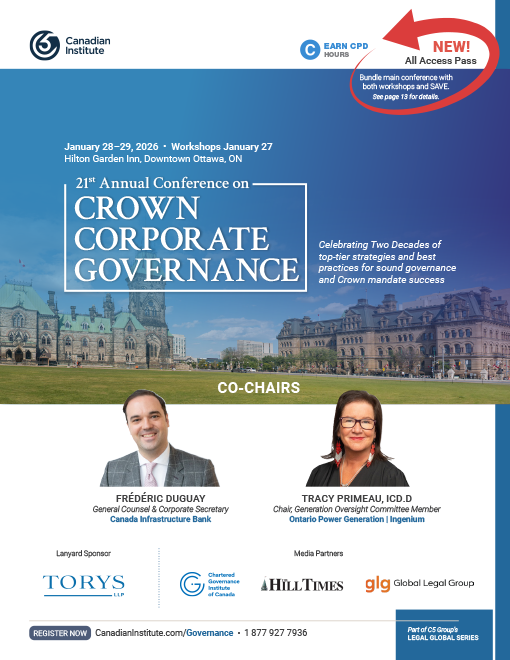
Flip through our conference brochure and discover what’s new this year.
Download Brochure
Pre-Conference Workshops
January 26, 2027
Day 1 – Main Conference
January 27, 2027
Registration and Breakfast
Crown Corporations as a Vehicle of Public Policy: How Boards and Executives Navigate the Inherent Tension Between Independence and Accountability

Randy JackiwAssistant Deputy Minister, Economic DevelopmentOntario Ministry of Agriculture

Nicole BonnellDirectorMarine Services Transition Initiative

Mark YoungGeneral Counsel & Corporate SecretaryCanada Mortgage and Housing Corporation

Tess LofskyEVP & General CounselCanada Development Investment Corporation

Frédéric DuguayExecutive VP, Chief Legal and Information Officer Canada Infrastructure Bank
Crown corporations are unique vehicles for advancing public policy objectives in Canada. Their quasi-private nature separates them from other government agencies, boards, and commissions, yet they must still comply with the Financial Administration Act, government regulations, and follow the direction of the Shareholder, all while maintaining an arm’s-length relationship.
This session will examine the traditional and evolving governance landscape for Crown corporations, helping boards and executives navigate the balance between independence and accountability while responding to shareholder expectations, statutory obligations, and maintaining public trust.
Topics of discussion include:
- Distinguishing Crown corporations from government agencies, boards, and commissions
- Exploring the level of autonomy available to Crown corporations
- Navigating the arm’s-length relationship with the Shareholder
- Understanding where government direction ends and board fiduciary responsibilities begin
- Considering the Supreme Court of Canada appeal of the Ontario Protector’s Place Act, which attempts to exempt Ontario Place from certain regulations and immunizes the Crown corporation, and its agents, from legal challenge
- Analyzing when a Crown corporation is the most effective vehicle for advancing certain objectives
- Assessing the inherent logic underlying the scheme, the degrees of independence, and the different levels of authority available to Crown Boards
- Managing situations where public policy objectives create tension with commercial and operational considerations
- Lessons learned from recent examples where Crown corporate governance structures were tested by public scrutiny or government intervention
- Considering recent examples of new plans to create or convert Crown corporations (e.g., Marine Services Transition Initiative, Build Canada Homes)
Break
Fireside Chat with the PCO – The Future of Crown Corporations: Government Priorities, Expectations and Governance Transitions

Isabelle MondouDeputy Clerk | Associate SecretaryPrivy Council Office | The Cabinet of Canada
Isabelle Mondou, Deputy Clerk of the Privy Council and Associate Secretary to the Cabinet, will participate in a special fireside chat dedicated to exploring the future of Crown corporations.
Questions of discussion may include:
- What governance strengths does PCO consistently observe among high-performing Crown corporations?
- What governance gaps are most commonly encountered?
- How should boards prepare for evolving government priorities?
Break
Developing a Roadmap for Responsible AI Adoption in Crown Corporations: Building AI Literacy, Governance, and Risk Management

Joel RamsayPartnerTory’s LLP

Richard Barber, ICD.D., GPC.D.CEO | Board DirectorMind Tech Group | GPC
Although the reliability of generative AI continues to be challenged, it has been successful at streamlining workflow and improving efficiency. Regardless of how AI is used, it is critical to develop AI policies and governance systems that ensure AI is implemented and used responsibly, efficiently, and consistently.
This session will provide a practical roadmap for building AI literacy, establishing fit-for-purpose governance frameworks, and implementing AI responsibly across Crown corporations while maintaining effective board oversight, managing risk, and supporting operational efficiency.
Topics of discussion include:
- Examining when and how Crowns can safely implement AI systems into their daily functions
- Harmonizing conversations between management and the Board on the adoption and use of AI
- Determining what information boards should receive regarding AI deployment, risk and performance
- Establishing appropriate board oversight without becoming involved in operational implementation
- Assessing and mitigating the data and privacy risks involved with AI systems
- Determining whether existing governance structures are sufficient or whether dedicated AI oversight mechanisms are warranted
- Considering policies such as the Treasury Board of Canada Secretariat’s AI Strategy for the Federal Public Service; and the federal governments’ recently launched AI for All strategy
- Understanding organizational liability when AI-assisted decisions produce inaccurate or unintended outcomes
- Distilling lessons from recent case law on challenging decisions made with AI
Networking Luncheon
Building High-Performing Boards: Strengthening Director Effectiveness Through Onboarding, Evaluation and Continuous Development

Chris DayChairOntario Educational Communications Authority (TVO)

Ivy LumiaFounder & CEOBest in Governance

Eryn SibaExecutive Director, Crown GovernanceCrown Investments Corporation

Hemant SudDirector, Board Effectiveness & Data AnalyticsHansell LLP

Okenge Yuma Morisho, LL.L., MBALeadership ConsultantThe Coaching StudioFormer Deputy Minister, BC
The effectiveness of the board is contingent on the training and support it receives. From comprehensive onboarding that equips new directors to contribute with confidence, to meaningful evaluations that promote accountability and continuous improvement, every stage of the director lifecycle shapes board performance.
This session will examine practical strategies for helping directors understand their roles, align with the Crown corporation’s mandate, and continually strengthen individual and collective effectiveness.
Topics of discussion include:
- Developing onboarding frameworks that accelerate director readiness and establish clear governance expectations
- Clarifying the respective roles of the board, management, the Chair, the CEO and the Minister to strengthen decision-making and accountability
- Navigating diverse professional backgrounds, communication styles and public-private sector perspectives to foster productive board dynamics
- Designing evaluation processes that measure both individual contributions and collective board effectiveness while promoting fairness and credibility
- Leveraging evaluation outcomes to support continuous development, succession planning and stronger governance practices
Break

Iman Hashemi, M.Eng.President & CEOOntario Clean Water Agency

Tanya Gracie, MBA, ICD.DChair, Audit Committee & Board MemberNational Capital Commission

Ryan BarryManaging Director, Head of Enterprise RiskCPP Investments

Tania Clarke FCPA FCA, CPA (US), ICD.DMember, Audit & Risk CommitteesBDC

Alexandra SchwarzVice-President and Chief Legal Officer FinDev Canada
In an environment where new risks dominate headlines almost daily, boards may struggle with identifying the risks that require meaningful oversight. At the same time, unclear boundaries between governance and management can lead to inefficient discussions, crowded agendas, and uncertainty about where oversight ends and operational responsibility begins.
This session will explore how boards and management can become more aligned on risk identification and oversight, ensuring attention is focused on risks that truly matter while fostering a productive, trust-based relationship that supports effective decision-making.
Topics of discussion include:
- Distinguishing strategic and enterprise risks from operational issues, emerging trends, and headline-driven concerns.
- Prioritizing risks based on organizational mandate, public-sector context, and potential impact rather than external noise or perceived urgency
- Identifying the key risks that deserve sustained board attention versus periodic monitoring
- Clarifying the respective roles of boards and management in identifying, assessing, and responding to risk while respecting the “noses in, fingers out” principle.
- Strengthening board–management dialogue through frameworks that encourage constructive challenge, transparency, and mutual accountability.
- Avoiding risk-reporting fatigue caused by overly detailed dashboards and risk inventories and creating a common risk language between directors and management
- Adapting oversight approaches of management and the board to different categories of risk
- Recognizing when boards should take a more active governance role and when management should be afforded greater autonomy.

Brian RadfordGeneral Counsel | Acting Deputy CommissionerOffice of the Public Sector Integrity Commissioner of Canada

Harriet SollowayCommissioner Office of the Public Sector Integrity Commissioner of Canada
Conference Cocktail
Conference Adjourns
Day 2 – Main Conference
January 28, 2027
Registration

Justine HendricksPresident & CEOFarm Credit Canada

Jane HalfordChairFarm Credit Canada

Fred DemarkerPresident & CEOAtomic Energy of Canada Limited

Jim BurpeeChairAtomic Energy of Canada Limited

Colleen OulletteDirector & Corporate SecretaryExport Development Canada
In this special roundtable, the Chair and CEO of Crown corporations will provide their insights into what makes governance and communication most effective.
Questions of discussion will include:
- What is the hardest governance conversation a Chair and CEO must have?
- What are the early indicators that the Chair-CEO relationship is becoming challenged?
- How should disagreements be surfaced and resolved?
- What governance practices create the greatest value but receive the least attention?
Break
Governance and Operational Strategies for Supply Chain Resilience: Responding to CUSMA, Tariffs, International and Canadian Federal Policies

Kathy BrightVice-ChairpersonPacific Pilotage Authority

Glen HodgsonFellow | Senior Fellow CSA Public Policy Centre | C.D. Howe Institute
The federal government’s new Buy Canadian Policy requires federal departments and agencies to prioritize Canadian suppliers and Canadian content in strategic procurements and is expected to extend to most Crown corporations. This and other developments in Canadian and international trade policy, including evolving tariff measures and shifting supply chain priorities, have important implications for Crown corporations’ governance, risk management and strategic planning.
This session will examine how Crown corporations can translate these shifting policy priorities into effective procurement decisions, strengthen supply chain resilience and balance domestic economic objectives with operational needs.
Topics of discussion will include:
- Understanding how the Buy Canadian Policy represents a major shift in federal purchasing activities
- Analyzing the board’s role in overseeing supply chain resilience
- Leveraging procurement as a strategic tool for strengthening Canada’s economy, industrial base and supply chain resilience
- Unpacking the latest developments with respect to US trade tariffs and other international developments
- Navigating the impact of Canadian, US and international policy changes on supply chain management
Break

Josephine PalumboDeputy Commissioner of CompetitionCompetition Bureau of Canada
Achieving Bold Objectives and Financial Sustainability with Responsible Oversight: Strategies for Mitigating Risk in the Pursuit of Government Objectives

Nirpendra Ajmera, CIA, CISA, CFEChief Audit ExecutiveQulliq Energy Corporation

Wilhelm RinasGeneral Counsel (A)Ontario Clean Water Agency

Danielle TownleyChief Legal Officer & General CounselBuilding Ontario Fund
Frédéric DuguayExecutive VP, Chief Legal and Information Officer Canada Infrastructure Bank
The federal government has set out priorities that call on Crown corporations to be more ambitious and take bigger risks. Yet Crown corporations must remain true to their mandates and, as vehicles for achieving government policy, must employ due diligence and responsible oversight when taking on new opportunities or strategies.
This session will explore the factors that must inform a Crown corporation’s approach to risk amid heightened government expectations and a renewed focus on delivering public priorities, offering practical strategies for achieving government objectives and financial sustainability with prudent oversight.
Topics of discussion include:
- Defining an appropriate risk appetite when government policy objectives require innovation, investment, or accelerated execution
- Recognizing situations where avoiding risk may create larger strategic risk than taking action
- Evaluating the use of current risk analyses and matrices and flagging areas for improvement or change
- Future-proofing processes and reporting to maintain transparency and agility amid change
- Assessing the use of insurance as a tool for mitigating risk
- Integrating the development of crisis plans into risk strategy
- Delineating management response and board oversight during crises
- Identifying and reconciling unique risk factors and opportunities in public-private partnerships
Networking Luncheon
Harmonizing Indigenous Rights, Partnerships, and Corporate Governance: Building Trust, Advancing Projects

Hillary ThatcherExecutive Vice-President, Indigenous and Northen Infrastructure InvestmentsCanada Infrastructure Bank

Maude-Émilie PagéVice-President, Indigenous and Stakeholder RelationsAtomic Energy of Canada Ltd

Tracy Primeau, ICD.DMember, Board of DirectorsCanadian Nuclear Laboratories | Ontario Power Generation | Ingenium
- Moving beyond consultation toward long-term partnership and shared governance models
- Developing governance frameworks that support meaningful Indigenous engagement before, during, and after project lifecycles
- Embedding Indigenous knowledge and perspectives into governance structures, project oversight, and board decision-making to support sustainable, community-informed outcomes
- Strengthening relationships with Indigenous communities to foster strategic partnerships that improve project certainty, mitigate legal and operational risks, and create shared value
- Integrating Indigenous procurement, participation, and economic reconciliation objectives into sourcing strategies, contracting practices, and supply chain governance
- Navigating evolving legal obligations, including the duty to consult, UNDRIP, and free, prior and informed consent (FPIC), in the oversight of major projects
Break

Mante Molepo, ICD.DFounderMante Molepo Consulting

Marco P. FalcoPartnerTorkin Manes LLP
When workplace culture aligns with organizational objectives, it can strengthen governance, support prudent risk-taking, enhance resilience, and improve performance. When it does not, culture can quietly undermine strategy, weaken accountability, contribute to burnout, and create significant organizational risk.
This session will examine the critical role workplace culture plays in governance and risk management and explore how boards and senior leaders can intentionally shape, measure, and sustain cultures that support organizational success.
Topics of discussion include:
- Defining the values, behaviours, and expectations that shape organizational culture and influence decision-making across the Crown corporation.
- Diagnosing culture risk by identifying gaps between an organization’s desired culture and its actual workplace experience.
- Embedding accountability for culture through clearly defined governance, leadership, and management responsibilities.
- Reinforcing desired behaviours through talent management, succession planning, performance evaluation, compensation, recognition, and incentives.
- Linking individual director performance, board dynamics, and leadership behaviours to collective board effectiveness and strategic outcomes.
- Harnessing workplace culture to promote risk awareness, organizational resilience, employee engagement, and long-term sustainability, while addressing challenges such as burnout, change fatigue, and information overload.