Agenda
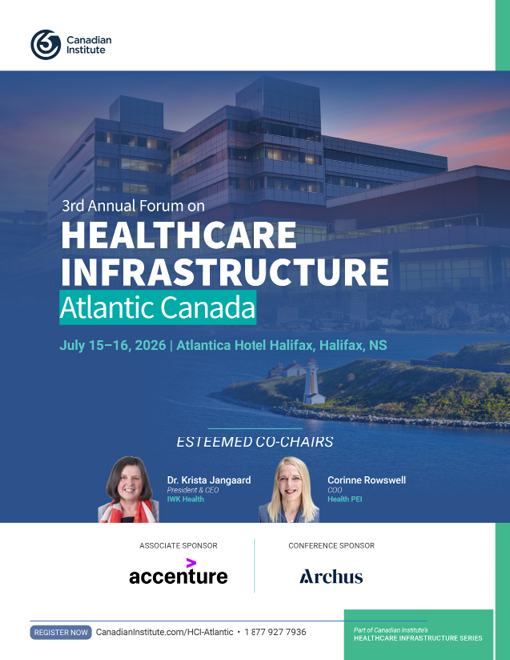
Flip through our conference brochure and discover what’s new this year.
Download Brochure
Day 1 — Main Conference
July 15, 2026
Registration Opens


Advancing the Healthcare Infrastructure Agenda in Atlantic Canada: How to Integrate and Accelerate Planning, Procurement and Project Delivery Innovation

David BenoitPresident & CEOBuild Nova Scotia

Andrew CrooksDirector Infrastructure Strategy and Planning Health System Infrastructure, Department of Health and WellnessGovernment of Nova Scotia

David HoManaging Director, National Lead, Health & Public SectorAccenture Infrastructure & Capital Projects

Morning Networking Break

Salah Afifi, NSAA, MRAIC, PMP, LEED APDirector Healthcare Infrastructure, Department of Public Works, Building Infrastructure Design and ConstructionGovernment of Nova Scotia

Tonya McLellan, P.Eng.Executive Director, Department of Public Works, Building Infrastructure Design and ConstructionGovernment of Nova Scotia

Marija Mojsilovic Govedarica, NSAA, MRAICManager Healthcare Infrastructure, Department of Public Works, Building Infrastructure Design and ConstructionGovernment of Nova Scotia

Terri-Lynn SmithSite Lead and Director of Operations and Re-Development CRHCC, Department of Public WorksGovernment of Nova Scotia
- Enhancing Emergency Department capacity
- Expanding Emergency Departments and optimizing design to improve functional flow, patient experience, and responsiveness to current and projected population needs
- Integrating hospital operations with construction
- Coordinating day-to-day hospital operations with active construction environments to maintain safety, continuity of care, and minimal disruption to clinical services
- Establishing a standardized provincial
- Developing a consistent, repeatable design and delivery framework that can be applied across healthcare facilities to ensure quality, efficiency, and alignment with system-wide goals
Alternative Spaces and Adaptive Reuse: Exploring Opportunities to Use Existing Infrastructure to Improve Access to Care in the Community

Jeff HardingDirector, Redevelopment, Space and LeasingIWK Health

Kimberly PikeClinical Project ManagerNL Health Services
There is immense pressure to improve access to healthcare across Canada, but the resources to build new are not always readily available. This session will explore how to leverage existing spaces to bring care closer to home.
- Assessing opportunities for adaptative reuse of buildings for healthcare services
- NL Hub
- IWK Women’s Clinic
- Understanding what is involved from a design/project delivery perspective
- Identifying and working through some of the challenges presented by spaces that are not purpose built
- Examining examples of adaptative reuse and leased spaces and the impact on community care
- Determining whether these options are financially sustainable
Networking Lunch

Marie-Luc JodoinVice-President — Transition and Activation servicesHealth Care Relocations
- Examining operational readiness and activation lessons learned from healthcare infrastructure projects across the country
- Identifying planning pitfalls and how to address them from the outset
- Strategies for working through phased projects

Emma LeeshanokIndustrial EngineerNova Scotia Health
Rebecca MacDonaldPrincipalParkin Architects

Corinne RowswellCOOHealth PEI
Mariska Janse van RensburgProject Manager, Facility & Capital PlanningHealth PEI
Kim LawnExecutive Director of Access & AffiliationHealth PEI
Project 1: Bayers Lake Community Outpatient Centre (Nova Scotia)
Project 2: (PEI) Health Centre
Afternoon Networking Break
Special Focus on Human Factors in Healthcare Design

Keith FrancisAssociate + Senior Director of Human FactorsForge Media + Design
Wayfinding and signage are essential elements of placemaking. The true impact of placemaking is shaped not only by what we see but also by how we feel about our experiences within a space. Wayfinding relies on cognitive functions like problem-solving and decision-making.
However, for many neurodiverse individuals, navigating environments can be especially difficult. In hospitals, emotionally charged and time-sensitive visits often lead to disorientation, confusion, frustration, and stress, which can negatively affect patients’ and visitors’ experiences.
The deeper context of signage and wayfinding is to liberate the act of mobility, to counterbalance the often-confusing contrasts between place and placelessness, seeing everything while seeing nothing.
This presentation will use immersive storytelling case studies to address the following topics:
- The importance of pre-discovery research, co-design and lived experience narratives driving wayfinding and signage master planning
- Being mindful of hubris in designing for disability
- Curating wayfinding and placemaking journey narratives
- The benefits of post-occupancy research
- The integration of donor recognition in healthcare master planning

Sarah ProdorArchitect, ConsultantTranslate Health
The built environment disables people, not brains. Neurodiversity describes the idea that people experience and interact with the world around them in many different ways; there is no one “right” way of thinking, learning, and behaving, and differences are not viewed as deficits. Our current hospitals should be designed to support our diverse population. Too often, brightly-lit, noisy and confusing hospitals create stress and anxiety for people that are seeking care and wellness. A neuroinclusive approach to design can alleviate environmental stressors so that patients can focus on healing and staff can focus on providing the best care possible.
In this presentation we will explore the following aspects of Neuroinclusive design:
- Understanding Neurodiversity
- Data review of why neuroinclusive design is critical in healthcare design today
- The sensory domains and principles of design
- Co-design and the ‘Nothing about us, without us’ movement
- The role of policy and procurement
Day One Toast.
Cheers! Networking & Prosecco Pour
Day 2 — Main Conference
July 16, 2026
Registration Opens

Christine ChadwickManaging DirectorArchus Canada

Derek SpinneyVice President, Corporate Services, Infrastructure & Chief Financial Officer Nova Scotia Health

LeeAnn Larocque BN, RN, MHA, CHEActing Vice President Clinical Care & Chief Nurse ExecutiveIWK Health
Modernizing IT Infrastructure and Leveraging New Tools to Drive Efficiencies in Healthcare

Farnaz SadeghpourAssociate ProfessorUniversity of Calgary
Healthcare systems are under growing pressure to deliver better care amid rising demand, aging infrastructure, workforce shortages, and increasing operational complexity. This keynote explores how digital twins – real-time, data-informed virtual representations of physical systems – can make healthcare infrastructure more adaptive, efficient, and responsive to evolving demands. It will showcase the power of human-centric digital twins for healthcare infrastructure in enhancing patient care, assisting with diagnostics, and managing critical resources more effectively; ultimately improving patient experiences while supporting informed real-time decision making.
Morning Networking Break

Christine O’DonnellSenior Project ManagerColliers Project Leaders
In a follow-up to last year’s discussion, we will examine recent takeaways from the launch of One Person, One Record. The goal of this modernization project is to achieve greater interoperability at hospitals and across Nova Scotia’s health system for a more seamless healthcare experience. This session will offer provinces looking to pursue similar projects with a view of what worked, what didn’t and how to plan accordingly.
Our presenters will focus on:
- Providing insights on lessons learned now that the project is live
- How the team is measuring success
- Examining how the implementation will affect new and existing infrastructure as well as workflows
- Preparing staff to work differently as technology changes
- Exploring next steps—how the project will support future digital initiatives and transformation in support of patients and staff
A Healthcare Infrastructure Professionals Guide to AI: How Technology is Transforming How We Work and What We Build

Robyn StewartBusiness Solutions Director, Advanced Technology & AI NTT Data
Part I – AI trends shaping healthcare
- Demystifying AI and its applications
- Examining how AI capabilities are evolving and expanding around the globe
- Exploring how AI is influencing healthcare spaces
Part II – Practical use cases
- Identifying opportunities to automate and outsource decision making
- Integrating AI into workflows in a safe and responsible manner
- Public models vs. enterprise
Networking Lunch
Fireside Chat
Modernizing Construction to Meet Healthcare Infrastructure Demands: Critical Next Steps to Push the Industry and Major Projects Forward

Trent SoholtExecutive DirectorNova Scotia Construction Sector Council

Sabrina FiorellinoCEOFero International Inc.
David BenoitPresident & CEOBuild Nova Scotia
Global demand for infrastructure is rising. The construction industry needs to adapt and innovate to meet the needs of key sectors, like healthcare, faster. This session will focus on:
- Examining the current state of the industry—what’s working and what’s not?
- Exploring how research, innovation, and technological advancements are shaping the future of construction
- Assessing how this will influence the type of talent required on projects
- Addressing current barriers to modern methods of construction
- Determining what changes within the industry will help accelerate the delivery of healthcare infrastructure across the country
Afternoon Networking Break


Transitioning Hospitals to Biomass Energy: Evaluation and Integration of this Carbon Reduction Method

Ian McDiarmidDirector, Infrastructure and PlanningCape Breton Regional Hospital
Nova Scotia has set a target of 80% clean electricity by 2030. To meet this goal, the province is starting to transition public buildings, including hospitals to bioenergy, which involves the use of energy from organic materials to produce heat or electricity.
Cape Breton Regional Hospital is currently in the process of integrating a new state-of-the-art energy centre that will burn 60% wood chips, that will be sourced locally.
This session will focus on:
- Defining biomass and bioenergy
- Examining the decision to choose biomass instead of other green energy options like solar
- Describing how bioenergy will help advance provincial sustainability goals
- Outlining potential benefits and challenges that come with the use of biomass
- Providing insight into the process of integrating the new energy centre into Cape Breton Regional Hospital