Agenda
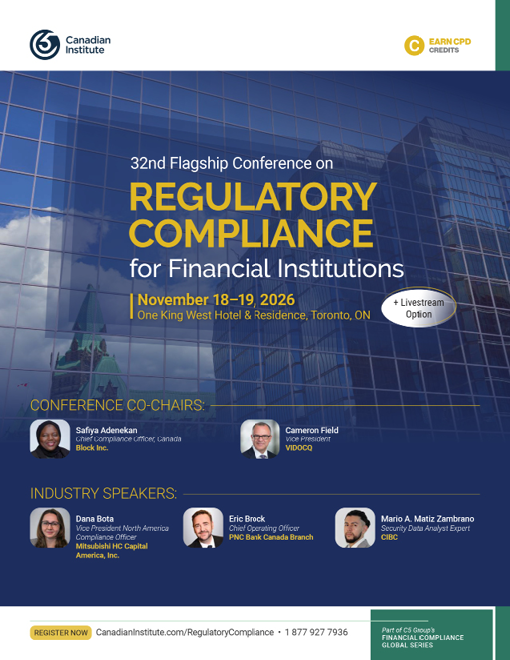
Flip through our conference brochure and discover what’s new this year.
Download Brochure
Pre-Conference Workshops
November 17, 2026
Day 1 – Main Conference
November 18, 2026
Registration and Breakfast Available


Aditya AnneSenior Director, Head of AI Safety and Governance EngineeringCIBC

Joseph IusoCAMS, CFCS, Global Regulatory AffairsKYC2020

Carole PiovesanManaging PartnerINQ Law

Claudia FuchsSenior Director, Retail and Commercial ComplianceNational Bank of Canada
AI governance is becoming a real business issue, not just a theoretical one. This session will focus on the concrete practices needed to approve, validate, monitor, and oversee AI systems in regulated environments. We will discuss:
- Establishing structured intake, risk‑tiering, and documented business justification for every AI deployment
- Managing privacy and auditability with strong data controls, traceability, and evidence that automated decisions meet regulatory expectations
- Running continuous validation to detect drift, errors, and customer‑impact risks before they escalate
- Governing generative AI, shadow AI, and experimentation to prevent unmanaged or unauthorized risk
- Preventing bias and poor outcomes with fairness testing, scenario reviews and guardrails to protect vulnerable customers
- Strengthening oversight and building trust between technical teams and compliance through shared controls, documentation, and transparent model behaviours
INTERACTIVE ROUNDTABLE DISCUSSION
Applying AI in Financial Services: Practical Use Cases, Emerging Risks, and Real‑World Adoption Challenges
These small-group conversations are a chance to compare how AI is actually being used across financial services, what’s working, what’s stalling, and where teams are encountering friction.
Discuss persistent barriers around data, governance, testing, and regulatory uncertainty. Share practical lessons and approaches for building effective AI strategies.
- Where is AI actually improving day-to-day work in your organization, and where does adoption still stall?
- What data or governance gaps most often slow down AI deployment across your teams?
- How are emerging AI rules affecting how you design, test, or approve new AI use cases?
- What real-world lessons or approaches have helped you move AI projects from experimentation into production?
Networking Break


Dana BotaVice President North America Compliance OfficerMitsubishi HC Capital America, Inc.

Eric BrockChief Operating OfficerPNC Bank Canada Branch

Jessica KimDirector, Third Party Risk ManagementSun Life Financial
This session will explore how financial institutions are tightening vendor oversight and resilience practices as new guidelines reshape expectations for critical operations, incident response, and technology risk.
- Aligning third‑party, technology, cyber, and resilience controls into one governance model
- Meeting new regulatory standards: Adapting to OSFI’s evolving expectations for critical operations, vendor concentration, and incident response
- Applying global best practices and international approaches that modeled RPAA-style frameworks (Retail Payment Activities Act)
- Shifting from outsourcing critical systems to rebuilding internal capabilities for greater control and resilience.
These small-group discussions are a chance to compare how different financial institutions are approaching third-party risk, what’s working, where teams are running into friction, and how people are adapting to OSFI’s expectations.
Discuss practical challenges around vendor oversight, compliance alignment, and cross-border dependencies, and share real-world steps that help strengthen third-party risk programs.
- How is your organization interpreting and applying OSFI’s B-10 requirements for vendor oversight and resilience, and where do you see the biggest challenges?
- How are you integrating third-party controls with AML, privacy, and cyber obligations, and where do these requirements create friction or gaps?
- What issues arise when managing foreign branches, data-location constraints, or jurisdictional requirements, and how are you addressing them?
Networking Luncheon


Peter AzizSenior CounselTorys LLP
Administrative Monetary Penalties (AMPs) are reshaping how regulated entities including banks, Payment Service Providers (PSPs), and Money Service Businesses (MSBs) approach accountability, remediation, board oversight, and engagement with OSFI.
This session outlines what AMPs mean for day‑to‑day compliance operations and how institutions can prepare for a more assertive supervisory environment.
- Interpreting OSFI’s new model and heightened supervisory expectations, and the shift toward more proactive enforcement
- Clarifying accountability, strengthening remediation processes and elevating board reporting
- Competing under stricter standards and aligning frameworks, governance and board involvement to remain competitive in a more demanding regulatory landscape
- Implementing key guidelines: Applying E‑13, B‑10, and B‑13 across compliance, third‑party risk, cyber, and governance functions
Networking Break

Emily HassinPresidentHassin Dawson Law Group

Safiya AdenekanChief Compliance Officer, CanadaBlock Inc.

Kuno TuckerChief Compliance OfficerManulife Securities
Compliance teams, especially in small and mid‑sized institutions are being asked to absorb more regulatory change, more technology risk and more board scrutiny while operating with tighter budgets and fewer people.
This session explores practical, applicable ways to prioritize work, communicate effectively with leadership, and modernize compliance operations without overengineering.
- Prioritizing what matters and focusing limited resources on the highest‑impact risks, regulatory changes, and control gaps
- Right‑sizing compliance teams: Clarifying CCO accountability, addressing talent shortages, and defining what a modern compliance function should look like
- Leveraging technology using automation, metrics, and workflow tools to scale oversight with fewer people
- Improving board communication: Demonstrating effective controls, simplifying reporting, and elevating issues that require board attention
Closing Remark from the Co-Chairs and Day 1 Adjourns
Day 2 – Main Conference
November 19, 2026
Registration and Breakfast Available


David HooperVice President, Banking and Payments Consulting
Toronto Financial Services (TFS)CGI

Ishita SahaSenior Manager, Enterprise Payments Standards & MonitoringTD Bank Group
Canada’s shift toward consumer‑directed banking and instant, data‑rich payments will compress the time available to detect and disrupt fraud and laundering, while intensifying expectations around consent, identity assurance, and continuous monitoring.
This session will explore how institutions can modernize controls and readiness in an evolving sector. Topics will include:
- Moving away from screen‑scraping toward secure, standardized API‑based access that reduces exposure and strengthens oversight
- Reinforcing identity frameworks by upgrading KYC and identity verification to counter synthetic identities, account takeover and rapid‑movement fraud in an instant‑payments environment
- Engineering real‑time intervention that can act within seconds when payments are irrevocable and fraud attempts accelerate
- Implementing privacy‑aligned consent, access and data‑use practices that still enable effective AML monitoring and investigative workflows
- Applying structured, real‑time payments data to sharpen detection and improve risk‑signal accuracy
INTERACTIVE ROUNDTABLE DISCUSSION
Stablecoin Legislation and Consumer‑Driven Banking: Implications for Compliance Teams
These small-group discussions will explore how compliance teams are preparing for Canada’s Stablecoin Act and Consumer-Driven Banking Act.
Discuss key impacts on AML/ATF, fraud, identity, consent, and operational readiness, and share practical steps for implementation.
- Where do stablecoin regulation and consumer-driven banking intersect, and what is proving hardest to operationalize?
- How are stablecoins and real-time data sharing changing AML/ATF and fraud risks?
- What identity, consent, and data governance challenges are you anticipating?
- What are your top priorities for readiness and implementation?
Networking Break

Lisa HarpleyDirector of Financial Crime Program, Operations and IntelligenceCoast Capital Savings

Charles Victor GonzalesDirector, AML Regulatory ComplianceDigital Commerce Group

Vladimir ShatiryanPartnerBlake Cassels & Graydon LLP
Hear directly from seasoned practitioners who have navigated FINTRAC examinations, uncovering the critical steps that institutions must take to demonstrate compliance maturity. This session delivers practical, experience-based guidance to help organizations strengthen readiness, avoid deficiencies and elevate their AML programs ahead of heightened regulatory scrutiny. Topics of discussion will include:
- Preparing for examinations and understanding where FINTRAC is placing emphasis
- Assessing how examination methods, expectations, and communication styles are shifting as oversight intensifies
- Identifying what recent audits reveal about organizational gaps, control weaknesses, and opportunities for targeted improvement
- Identifying where deficiencies most commonly arise and how institutions can mitigate high‑risk exposure points
- Anticipating the types of questions FINTRAC may ask and recognizing overreach
Keynote
Networking Luncheon

Mario Alejandro Matiz ZambranoSecurity Data Analyst ExpertCIBC

Imran AhmadPartner, Canadian Head of Technology and Canadian Co-Head of Cybersecurity and Data PrivacyNorton Rose Fulbright Canada LLP
Financial institutions face growing pressure to show that cyber and technology risks are being identified, measured, remediated and reported with clarity.
This session explores how organizations translate technical findings into meaningful executive and board‑level insights aligned with OSFI B‑13, operational resilience expectations, and third‑party risk guidance.
- Transforming technical risk data such as vulnerabilities, patching, control gaps, incidents, third-party findings and resilience indicators into clear, decision‑ready reporting
- Meeting OSFI B‑13 expectations across governance, incident response, third‑party oversight, and operational resilience
- Improving cyber risk communication and reporting that supports executive understanding, board oversight, and credible regulatory engagement
Networking Break
Financial Action Task Force (FATF) Mutual Evaluation and Canada’s AML Readiness: Implications, Expectations, and Institutional Preparation

Noah ArshinoffExecutive Director, Policy and Public AffairsFederation of Law Societies of Canada

Andrew MorrisFounder & PrincipalAlphaDelta Advisory Group/Faculty, Osgoode Professional Development

Christine RingVP, AML Advisory Canada and Caribbean, Financial CrimesRBC
Canada’s upcoming FATF evaluation will shape both its global AML reputation and the intensity of domestic regulatory scrutiny. This session will help financial institutions assess their readiness, identify gaps, and align controls with international expectations so they can demonstrate effectiveness and maintain regulator confidence in a high‑stakes environment.
- How the 2026 Mutual Evaluation will influence supervisory intensity, expectations, and reputational risk for Canadian institutions
- Learning from global enforcement using takeaways from recent international actions and how they translate into Canadian readiness requirements
- Preparing non‑bank institutions and addressing expectations for credit unions, securities dealers, and other non‑bank financial entities

Audrey MocleExecutive DirectorOpen MIC

Sarah NevilleDirector, Policy DevelopmentCanadian Coalition for Good Governance
Boards are increasingly expected to set the tone for AI adoption, shaping culture, strategy, and risk appetite, yet many are still building the expertise needed to oversee rapidly evolving technologies. This session explores how boards are refreshing their skill sets, identifying blind spots, and using clearer reporting to turn AI risk data into informed decisions and regulatory‑aligned actions.
- Clarifying board roles in AI governance: How directors are building literacy, recognizing blind spots, and aligning oversight with strategy and risk appetite
- Improving AI reporting and risk indicators and turning analytics, controls, and performance data into decision‑ready insights for boards and senior management
- Understanding what regulators expect from boards and adopting best practices for oversight, documentation, and accountability