Agenda
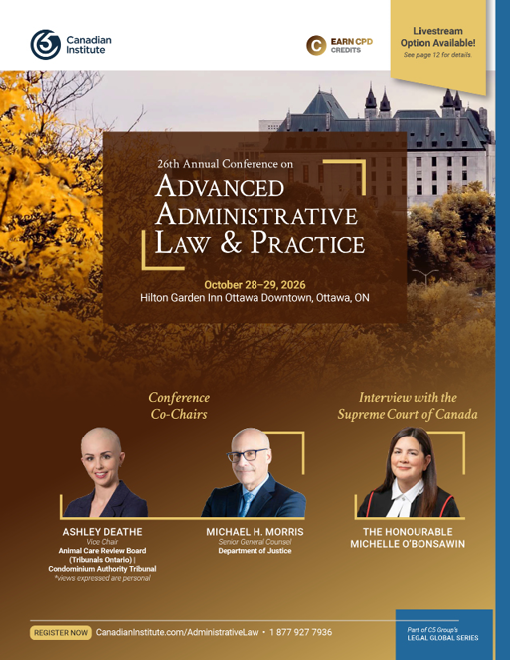
Flip through our conference brochure and discover what’s new this year.
Download Brochure
Pre-Conference Workshops
October 27, 2026
Day 1 — Main Conference
October 28, 2026
Registration and Breakfast

Ashley DeatheVice Chair Animal Care Review Board (Tribunals Ontario) | Condominium Authority Tribunal*views expressed are personal

Matthew EstabrooksPartner & National Co-Lead, Admin Law GroupGowling WLG

Michael H. MorrisSenior General CounselDepartment of Justice
Artificial Intelligence in Advocacy and Decision-Making: The Latest Legal, Ethical and Operational Developments

Chantal BernierCo-Chair, Global Privacy & Cybersecurity GroupDentons LLP

Valentine GoddardLawyer | FounderAI Impact Alliance | UNESCO’s Ethics of AI Unit

Jonathan MacdonaldDirector, AI StrategyTreasury Board of Canada Secretariat

Julie BarilDirector of Legal AffairsTribunal administratif du Québec
Matthew EstabrooksPartner & National Co-Lead, Admin Law GroupGowling WLG
Advancements made possible by artificial intelligence continue to be tempered by concerns around privacy and how unreliable the information provided by AI can be. In addition to hallucinations, AI can be used to create evidence (“deepfakes”) or improperly fill out forms. Nevertheless, AI can be seen as facilitating access to justice, both by reducing administrative demands on decision-makers and staff, and when it is used as a tool by litigants, especially those who self-represent. Balancing these advancements with appropriate caution is imperative, and this session will provide attendees with insights for the responsible use of AI.
In this session, topics of discussion include:
- Exploring how AI is or is not reducing administrative burdens
- Considering frontline uses of AI, e.g., AI-generated initial complaints or AI messages with registrars and case management officers
- Appreciating how well-developed internal AI policies can mitigate AI risks
- Determining whether existing governance structures are sufficient or whether dedicated AI oversight mechanisms are warranted
- Understanding organizational liability when the use of AI produces inaccurate or unintended outcomes
- Referring to policies such as the Federal Directive on Automated Decision-Making; AI Strategy for the Federal Public Service; and the federal government’s recently launched AI for All strategy
- Demystifying privacy and confidentiality when using AI: what happens to AI inputs, how is that information at risk, and how can it be protected?
Networking Break

Honourable Michelle O’BonsawinSupreme Court of Canada
CI is honoured to welcome Justice O’Bonsawin to the conference for a special fireside chat on administrative law principles.
An Abenaki member of the Odanak First Nation, Justice O’Bonsawin frequently speaks on Indigenous issues, as well as mental health, labour, and privacy law, and has written many publications that are relevant in the administrative law context, such as:
- A Difficult Road to Justice: The Relationship Between Mental Health and Access to Justice (2024)
- A Principled Approach: Applying Gladue Principles at the Ontario Review Board (2018)
- Mental Health Checklist: A Guide for Members of the Judiciary (2016)
Networking Break
Making Decisions Within Statutory Limits: Following New Direction from the Courts on Interpreting Jurisdiction

Joseph ChengSenior General CounselDepartment of Justice

Lauren J. Wihak, K.C.PartnerMcDougall Gauley LLP

Marco P. FalcoPartnerTorkin Manes LLP
Recent decisions of from the courts have emphasised statutory constraints as a primary limiting principle of Vavilovian reasonableness. Courts have been increasingly insistent on rigorous textual and contextual analysis, with increasing reliance on findings of only one reasonable interpretation. This session will explore several recent examples of where improper statutory interpretation that failed to meet this new emerging rigorous standard, led to unanticipated results, and what decision-makers and their counsel must now consider as a result.
Topics of discussion include:
- Appreciating the impact of improper statutory interpretation and how an OEB “opinion” was a judicially-reviewable decision in West Whitby Landowners Group Inc. v. Elexicon Energy Inc., 2025 ONCA 821
- Analyzing the role that statutory interpretation played in finding a Canadian Transportation Agency rate-setting decision unlawful in Canadian National Railway Company v. Canada (Transportation Agency), 2025 FCA 184
- Navigating the complexities of statutory interpretation in the municipal context, with a special look at Quebec’s unique approach: Ville de Québec v. Jardins de Vérone S.E.C., leave granted by the Supreme Court
- Grappling with dynamic statutory interpretation
- Unpacking the latest guidance on how appeal courts review administrative decisions post-Auer in Canada v. Responsible Plastics Use Coalition et al., 2026 FCA 17
- Translating the takeaways from these cases into strategic guidance for decision-makers and the counsel who defend or challenge these types of decisions
Networking Luncheon
Administrative Tribunal Roundtable: Practical Steps for Reducing Backlogs and Ensuring Access to Justice

Hugues Lafrance-RodrigueLegal CounselAdministrative Tribunals Support Service of Canada | CIRB

Angela LinPensions AdvocateVeterans Affairs Canada

Nabila QureshiStaff LawyerIncome Security Advocacy Centre

Christopher RoothamBoard Member Federal Public Sector Labour Relations and Employment Board
Ashley DeatheVice Chair Animal Care Review Board (Tribunals Ontario) | Condominium Authority Tribunal*views expressed are personal
Reducing backlogs and ensuring access to justice are, tritely, key goals of administrative bodies in Canada – but even those efforts must be compliant with statutory mandates, as the Ontario Divisional Court has recently directed. What does that mean for Tribunals and administrative bodies who are working to reduce backlogs? A special roundtable of speakers from administrative tribunals will unpack what that means in practice, and offer examples of efforts to reduce backlogs.
Questions and themes of discussion will include:
-
Appreciating why delay at the Ontario Human Rights Tribunal and the External Review Committee of the Royal Canadian Mounted Police were at issue in two recent court decisions: Bokhari v. Top Medical Transportation Services, 2026 ONSC 1073 and Benison v. Canada (Royal Canadian Mounted Police External Review Committee), 2026 FCA 53
- What does it mean to enact efficiency measures that are compliant with statutory mandates?
- Procedure as both advancing and preventing access to justice: when are procedural mechanisms used as a barrier to access justice and when are they necessary to reduce backlogs?
-
Appreciating the role of front line staff for education and managing evidence
- What other tools can be used to manage an influx of applications (e.g., youtube videos, “how to” sheets, telephone hotlines, etc)
-
Why is “hiring more adjudicators” not always the answer?
- The advantages and risks of using discretion to decline hearings
- The role of “amicus curiae” style support for vulnerable parties
-
When is it expected or reasonable for the tribunal member to negotiate or mediate between parties?
- When is ADR a better venue than a hearing room to ensure access to justice in a tribunal?
Networking Break
The Availability of Judicial Review in the Face of Privative Clauses: Recent Developments at the SCC

Sujit ChoudhryPrincipal Circle Barristers

Sarah DrodgeSenior CounselDepartment of Justice

Alison GrayPartnerGowling WLG

Teagan MarkinPartner and Co-Chair, Appellate & Public Advocacy GroupsBLG

Mark ManciniAssistant ProfessorThompson Rivers University, Faculty of Law
Michael H. MorrisSenior General CounselDepartment of Justice
In Yatar (2024 SCC 8), the SCC clarified a key point in administrative law: judicial review is available on questions of fact or mixed fact and law, despite legislation granting limited statutory rights of appeal. How to interpret this point in the face of privative clauses limiting review rights was recently addressed by the SCC in the Democracy Watch appeal (2026 SCC 28) and will be addressed by the SCC in the pending appeal Canadian National Railway Company v. Alberta Pacific Forest Industries Inc. This session will guide litigators and decision-makers in understanding what the former, a landmark ruling, means for the future of privative clauses, including the anticipated outcome of the latter appeal.
Topics of discussion include:
- Analyzing the implications of the Democracy Watch decision for future availability of privative clauses
- Anticipating potential legislative reactions to the ruling
- Assessing what the ruling means for ongoing litigation involving privative clauses
- Understanding the facts and issues of the CNRC appeal
- How s. 18.5 of the Federal Courts Act restricts judicial review and the implications for those aggrieved by an Agency decision
- The Governor in Council’s role in reviewing a regulator’s reasons for compliance
- Assessing how courts are distinguishing between errors of law, fact, and jurisdiction under partial or full privative clauses
- Understanding what litigators and decision-makers need to consider differently when faced with a judicial review versus appeal
Networking Break
The Evolving Intersection of the Charter and Administrative Law: Charter Rights, Charter Values, and the Applicable Standard of Review

Sean HanleyCounsel, Constitutional Law BranchMinistry of the Attorney General

Ewa KrajewskaPartnerHeinen Hutchinson Robitaille LLP

Zoe OxaalSenior General CounselDepartment of Justice

Alyssa TomkinsPartnerGowling WLG
Since the SCC affirmed that Charter values must be considered even when not expressly raised by the parties (Commission scolaire francophone v NWT, 2023 SCC 31), uncertainty remains about how those values should be identified and analyzed. Moreover, whether administrative or constitutional law governs when the Charter is engaged is also uncertain, although the SCC is expected to clarify through two appeals: one involving provincial access to information and freedom of religion and a second involving search and seizure issues from an Ontario Securities Commission order requiring the disclosure of texts and social media posts. This session will offer insights for how ADMs should navigate the Charter and how counsel should approach the standard of review.
Topics of discussion will include:
-
Reviewing the different standards of review for administrative decisions that engage a Charter right or value (Doré) and the standard of review used to ascertain whether the Charter was engaged (York Region)
- Understanding when administrative decision makers should or must explicitly conduct a Charter rights or values analysis in written decisions
- Analyzing two recent Federal Court cases that have addressed the question of Charter values: Robinson v. Canada (Attorney General), 2024 FC 2092 and Mombourquette v. Canada (Attorney General), 2024 FC 2093
-
Unpacking Vabuolas v. British Columbia (Information and Privacy Commissioner), 2025 BCCA 8, leave granted by the Supreme Court of Canada, and its treatment of Charter values and the appropriate standard of review
- When the Charter is engaged, should the standard follow constitutional law principles or administrative law principles?
- Staying attentive to the SCC’s opportunity to clarify whether Charter values analysis is appropriate in the context of a s. 8 Charter challenge to the reasonableness of a regulatory investigative summons
Cocktail Reception
Conference Adjourns to Day 2
Day 2 — Main Conference
October 29, 2026
Registration and Breakfast
Ashley DeatheVice Chair Animal Care Review Board (Tribunals Ontario) | Condominium Authority Tribunal*views expressed are personal
Matthew EstabrooksPartner & National Co-Lead, Admin Law GroupGowling WLG
Michael H. MorrisSenior General CounselDepartment of Justice
Making Sense of Government Immunity Within Constitutional and Administrative Law: the Notwithstanding Clause, Major Projects Legislation, and Ontario Protectors Place Appeal

Laura CárdenasLawyerLCM Avocats

Mannu ChowdhuryAdjunct Instructor, Constitutional Law York University, Osgoode Hall Law School

Jean-Simon (JS) SchoenholzPartnerNorton Rose Fulbright LLP

Jennifer KingPartner & National Co-Lead, Admin Law GroupGowling WLG
Federal and provincial governments have recently passed or attempted to pass legislation to immunize themselves from judicial review and/or the applicability of laws that serve as a check or balance: e.g., the invocation of s.33 of the Charter (the notwithstanding clause) by Quebec and Saskatchewan; Bill 5 and Bill C-5 (major projects legislation), and the challenge to the Rebuilding Ontario Place Act. This session will explore democratic accountability, the separation of powers, and constitutional limits on legislative authority.
Topics of discussion include:
- Revisiting the separation of powers and the constitutionality of judicial oversight legislative and executive authority
-
Reviewing the status of the lawsuits against Bill 5 and Bill C5
- Considering the impact of these laws on the duty to consult, the environment, and Indigenous rights
-
Unpacking recent provincial uses of the notwithstanding clause to immunize provincial laws against judicial review (English Montreal School Board, et al. v. Attorney General of Quebec, et al, and Saskatchewan (Minister of Education) v UR Pride Centre for Sexuality and Gender Diversity)
- Anticipating what these cases signal for the future of human rights
-
Assessing Ontario’s proposed legislation to exempt the redevelopment of Ontario Place from environmental protections
- Discussing the pending SCC decision challenging this development in Ontario Place Protectors v Ontario (SCC 41805)
Networking Break
When Bias or Apprehension of Bias Taints the Process: Impartiality, Recusal, and Remedy in Administrative Decision-Making

Lisa MalliaTribunal CounselHealth Professions Discipline Tribunals

Allison SmithArbitrator, Mediator, InvestigatorAllison Smith Dispute Resolution ServicesFormer Vice Chairperson, Canada Industrial Relations Board

Marisa VictorTribunal Member Canadian Transportation Agency
Ashley DeatheVice Chair Animal Care Review Board (Tribunals Ontario) | Condominium Authority Tribunal*views expressed are personal
Public confidence in administrative and adjudicative bodies is intrinsically tied to the impartiality of these bodies. As bias is not always overt, apprehensions of bias are treated with equal seriousness. In some cases, the line of questions that an adjudicator asks may ostensibly appear as “prejudging the outcome.” When bias is proven, or an adjudicator’s ability to decide fairly is called into question, what happens to the decision? This session will review the law and jurisprudence behind bias and offer practical insights for ADMs who are navigating allegations of bias.
Topics of discussion include:
- Reviewing what applicants must do to allege a claim of bias and navigating when a claim of bias is “waived”
- Considering situations where courts will overlook waivers
- Synthesizing the Supreme Court’s approach surrounding apprehension of bias
- E.g., Newfoundland Telephone Co. v. Newfoundland (Board of Commissioners of Public Utilities), [1992] 1 SCR 623, which set aside the decision, and Wewaykum Indian Band v. Canada, 2003 SCC 45, which (in obiter) did not
- Understanding how the apprehension of bias may exist in how an ADM conducts a hearing: Environmental Appeal Board v. District Director, Metro Vancouver, 2025 BCCA 303
- Developing practical strategies to avoid creating reasonable apprehension that the ADM, through active adjudication, has prejudged the outcome
- When is recusal appropriate?
- Reflecting on the outcome of Vento Motorcycles, Inc. v. Mexico, 2025 ONCA 82, an arbitration case which affirmed that the bias of one member taints any decision made by that body
Networking Luncheon
Judicial Review of Executive Decisions: The Procedural Complexities of Challenging Cabinet Decisions and Orders-in-Council
Sujit ChoudhryPrincipal Circle Barristers

John ProvartGeneral CounselDepartment of Justice Canada

Jessica OrkinPartnerGoldblatt Partners LLP

Cory GiordanoPartnerSupreme Advocacy
Michael H. MorrisSenior General CounselDepartment of Justice
The complexities of challenging cabinet decisions and Orders in Council have been illustrated in several recent and high-profile challenges: the Doug Ford mandate letters case (Ontario v. Ontario, 2024 SCC 4); the Emergency Powers case (Canada (Attorney General) v. Canadian Civil Liberties Association, 2026 FCA 6); and the challenge to the federal government’s Order in Council that banned certain firearms in 2020 (Canadian Coalition for Firearm Rights v. Canada (Attorney General), 2025 FCA 82, leave granted by the SCC). Since deliberative secrecy is at odds with administrative law principles of transparency and Vavilov-robust decision-making, this session will demystify the procedural complexities of challenging cabinet decisions and OICs.
In this session, topics of discussion will include:
- Revisiting cabinet privilege and its place within Canadian constitutional law and common law
- Unpacking procedural and evidentiary hurdles in challenging cabinet decisions
- Navigating issues relating to the record that can be produced in light of section 39 of the Canada Evidence Act
- Can the Federal Court order counsel- and party-only access to Cabinet confidences shielded from disclosure by a s. 39 certificate?
- Analyzing how cabinet confidentiality is treated separately from Governor-in-Council orders
- Summarizing the arguments raised in recent cases and evaluating what the Supreme Court’s disposition of these cases portend for the future
Networking Break
Advancing Accessibility, Mental Health and Active Adjudication: Strategies and Tools for Administrative Bodies and Decision-Makers

Leigh ClarkLawyerGillian & Hnatiw & Co

Melanie T. PetruniaActing Vice-ChairpersonSocial Security Tribunal of Canada, Appeal Division

Christopher T. SuttonAccessibility Commissioner of CanadaCanadian Human Rights Commission

Jay SenguptaAdjudicator/MemberJay Seungupta Dispute Resolution

Mante MolepoLawyer | Founder | CEOMante Molepo Consulting
Many parties, especially those who self-represent, are vulnerable: disability, mental health, economic barriers, social barriers, language barriers, racism, or simply because of the nature of the dispute itself. Trauma-informed approaches can be added to the active adjudication toolbox to satisfy substantive obligations while also facilitating access to justice. At the same time, federal administrative bodies must themselves comply with the Accessible Canada Act, and the tools available for navigating mental health and other barriers are equally valuable when applied internally. This session will equip ADMs with the knowledge and tools needed to facilitate accessibility and access to justice for vulnerable persons.
Topics of discussion include:
- Redefining the contours of active adjudication when dealing with vulnerable self-represented parties in often over-burdened administrative settings
- Appreciating the nuances of using discretion, with respect to procedure, for vulnerable self-reps: what are the minimums, and what are the limits?
- Navigating disability, accessibility and other accommodation requests
-
Understanding trauma-informed perspective and approaches to working with vulnerable self-reps
- Managing emotionally charged or unpredictable moments
- Balancing the procedural value of mediation or settlement discussions against re-traumatizing vulnerable parties
Networking Break
Administrative Decision-Making in the Immigration and Refugee Context: New Developments and the Influence of International Law and Policy

Mary LamPrincipal and Founder Mary Lam Law Office

Marianne ZoricGeneral CounselDepartment of Justice
Bernard AssanSenior CounselDepartment of Justice

Gib van ErtPartnerOlthuis van Ert
John ProvartGeneral CounselDepartment of Justice Canada
Immigration law has produced some of the key administrative law cases from recent years, including Mason and Pepa. The onus imposed on ADMs from these cases are affirmed in subsequent cases, although recent developments in immigration and refugee law disclose a focus on its intersection with both international law and the Charter. This session will unpack these developments and their implications for decision-making and immigration strategy.
Topics of discussion include:
- Revisiting the key takeaways from Mason and Pepa
-
Interpreting the implications of Mason’s affirmation that the Immigration and Refugee Protection Act must always be interpreted with Canada’s international obligations in mind
- Dissecting the relationship between enforcement of law under the IRPA and international policy in Sharif v. Canada (Public Safety and Emergency Preparedness), 2025 ONCA 711
- Distilling the Charter arguments raised in refugee claimant case R v. Kanyinda 2026 SCC 7
- Examining the trajectory of the treatment of immigration and refugee claims suggested by the calls to suspend the Canada-US Safe Third Country Agreement, and the concerns around Bill C-12
- Establishing best practices for ADMs to meet their decision-making obligations set by Vavilov, Mason, Pepa and recent developments