Agenda
Pre-Conference Virtual Workshops
Virtual Workshop A
May 5, 2026 | 1:00–4:30 pm ET
A Deep Dive into Charter Challenges and Police Authority Amid Civil Disobedience, Protests and Hate Crimes
Virtual Workshop B
May 7, 2026 | 1:00–4:30 pm ET
A Thorough Review of Top Complaints Against Officers, Their Legal Merit and the Finer Points for Conducting a Discipline Investigation
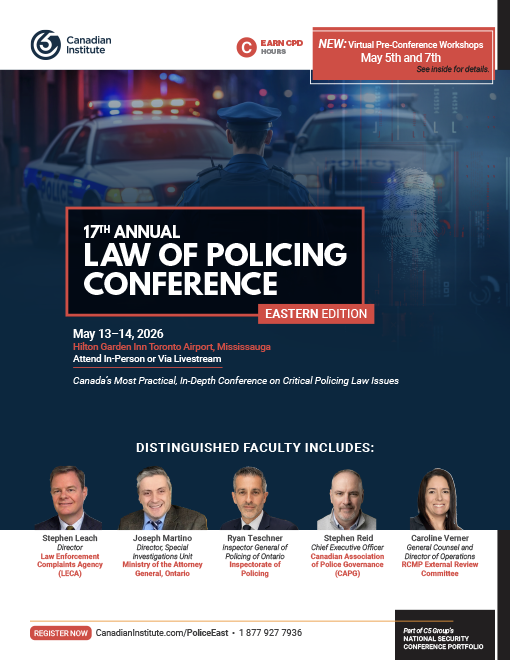
Flip through our conference brochure and discover what’s new this year.
Download Brochure
Day 1 — Main Conference
May 13, 2026
Registration Opens and Refreshments Served
One Year Review of the CSPA: Legislative Growing Pains, Conduct and Dismissals and Suspension Without Pay

Clayton CampbellPresidentToronto Police Association

Jason D. FraserGeneral Counsel, Legal ServicesYork Regional Police

Carla GoncalvesDeputy DirectorLaw Enforcement Complaints Agency (LECA)
The Ontario Community Safety and Policing Act (2019) (CSPA) came into effect in April 2024, bringing many changes including the ability for a chief to suspend an officer without pay. The circumstances for suspension without pay include when a police officer is convicted of an offence and sentenced to a term of imprisonment; and when a police officer is in custody or is subject to conditions of judicial interim release, or conditions imposed under section 499 of the Criminal Code (Canada), that substantially interfere with the officer’s ability to perform the duties of a police officer.
- Exploring the threshold for suspension without pay and chief’s discretion
- Calculating the matrix of what will be taking into account and how it will be used in practice
- Determining what a service needs to do to achieve suspension without pay, and what are the cases that would warrant
- Protecting the organization from wrongful dismissal lawsuits
- Examining what legal counsel can do under the new law
- Balancing the cost of a forced resolution: a guilty plea versus getting fired

Stephen LeachDirectorLaw Enforcement Complaints Agency (LECA)

Joseph MartinoDirectorSpecial Investigations Unit

Ryan TeschnerInspector General Policing of Ontario
This session will examine how Ontario’s three police oversight agencies are working in concert under the newly implemented Community Safety and Policing Act (2019) (CSPA).
- Examining how the CSPA is working in practice, gaps in the legislation, and anticipated amendments
- Comparing Ontario’s three oversight agencies, their mandates, and the interplay
- Determining the process for when multiple agencies are involved in one oversight investigation
- Update on how “service level” investigations are going, including timelines
- Best practices for keeping police out of the media, out of videos
- How are oversight agencies working with tribunals
Networking Refreshment Break

Fred FischerDirector, Litigation SectionCity of Toronto Legal Department

Alexandra MillerCounsel, Legal ServicesToronto Police Service
- Trends and statistics in civil litigation, what actions are being brought against police departments and municipalities, including negligent investigation, malicious prosecution, motor vehicles crashes and police pursuits
- Reasons why cases proceed or do not move forward
- Litigation involving the use of Body Worn Camera evidence in litigations, including Use-of-Force complaints
- Mitigating reputational risk of police services
Top 5 Legal Risks When Using AI in Policing – From Ethics and Privacy to Investigation and Evidence in Court

Justin AmaralLegal Counsel National Police Federation

Nye ThomasExecutive DirectorLaw Commission of Ontario (LCO)
- New, emerging legal considerations when adopting AI tools for police operations and administrative work
- Legal considerations for using AI tools for investigative work
- Evaluating the risks and benefits of using AI, including the risk of “hallucinations”
- Unpacking the ethics and legality of implementing AI tools, and using training data
Networking Luncheon for Speakers and Delegates

The Evolving Search and Seizure Authority and Challenges to the Canadian Charter of Rights and Freedoms

Chris SewrattanPartnerSewrattan Criminal Lawyers Professional Corporation
Director
South Asian Bar Association
Staff Sergeant Sheraz ArshadAir Support Unit and Strategic Initiatives Office, Emergency Management and Public Order UnitToronto Police Service
- Examining the Supreme Court of Canada’s decision in R v Campbell (2024) regarding a warrantless search of a cell phone
- Determining what additional steps police need to do to obtain a search warrant Examining the reasonable expectation of privacy in IP addresses, with a look at the SCC pending decision in R. v. Bykovets (2022)
- Ensuring the data can be searched, and examining R. v. Cuffie (2020) ONSC a look at whether the Crown’s disclosure of non-searchable PDF constitutes meaningful disclosure
Networking Refreshment Break

R. Kyle FriesenDirector, Legal Services and General CounselSurrey Police Service
Prepare for changes to the Youth Criminal Justice Act (YCJA). Bill C-14, aims to amend the YCJA, allowing police officers to publish information that identifies a young person when here is a public safety concern, with changes due to come into effect April 2025. This session will delve into the changes to the Act, how it might work in practice, and the nuances arising.
- Analysis of a young offender’s “blameworthiness” and their capacity to be judged as an adult
- Assessing if a youth sentence is sufficient
- Case study review of recent Supreme Court decisions setting precedent, including:
- Assessing the developmental age of an accused, with a look at R. v. I.M. (2025)

Meagan BlakeLegal CounselCalgary Police Service
R. Kyle FriesenDirector, Legal Services and General CounselSurrey Police Service
LCdr Jordan PremoLegal Advisor to the Strategic Joint StaffCanadian Armed Forces
This session will address the legal considerations involved with policing a planned major city events, with a look at case studies including the G7, the FIFA World Cup 2026 and the Taylor Swift concert in Toronto June 2025.
- Planning for major events
- Command structures
Closing Remarks from the Co-Chairs
Day 2 — Main Conference
May 14, 2026
Obligations for McNeil Disclosure of Disciplinary Records: What is Now Expected by the New Supreme Court Decision
Justin AmaralLegal Counsel National Police Federation

Jason NicolCrown Counsel, Crown Law Office, CriminalMinistry of the Attorney General
Samuel WalkerLead Counsel, Justice Prosecutions Unit, Crown Law Office Criminal Ministry of the Attorney General
This session will address the Supreme Court of Canada’s hearing of R. v. McKee (2023), concerning police disciplinary records being part of a disclosure package. The decision will impact the landmark Supreme Court of Canada decision in R. v. McNeil (2009) which expanded the scope of disclosure in criminal cases by imposing obligations on both the police and Crown prosecutors.
- Determining police obligations to disclosure member disciplinary records to Crown, in criminal procedure
- Examining what can and cannot disclosed to prosecution – first-party and third-party disclosure
- Reviewing R. v. McKee (2023) and comparing the landmark decision in R. v. McNeil (2009)
- Examining how McNeil disclosure files impact an officer’s assignment, and the departments allocation of resources
- Examining expungement, and/or how long an officer remains on the McNeil list
- How far back will police have to change their databases
The Finer Points of Conducting Internal Harassment Investigations of Sworn Officers and Civilian Police Staff: Reconciling Occupational Health and Safety Act and CSPA

Laura FlyerManager, Respectful WorkplaceToronto Police Service

D/Sgt. Thomas ReimerWorkplace InvestigatorToronto Police Service
- Conducting investigations of civilian police members who are not subject to the CSPA
- Finding the balance between human relations-style and professional standards-style investigation methods
- Delineating when a disability claim will force a hearing postponement, and when proceeding can move forward
- Analyzing how psychological issues impact a professional standard’s hearing including timelines and delays
- Addressing the medical evidence in a trial
- Outlining which medical information a physician can share with police and or an employer
Networking Refreshment Break
What to Expect from the RCMP’s Modernized Conduct Guide and Best Practices for Keeping People at Work amid Presumptive Dismissal
John MacLaughlanA/Senior Counsel, RCMP Legal ServicesDepartment of Justice Canada
S/Sgt. Jake HuttonRCMP

Caroline VernerGeneral Counsel and Director of Operations RCMP External Review Committee
The RCMP’s modernized Conduct Measures Guide for disciplinary decision was released in November 2024, in an effort to determine the most appropriate conduct measures. The guide includes the concept of presumptive dismissal for serious sexual misconduct.
- Examining why sex harassment misconduct will now lead to a presumptive dismissal sexual harassment, sexual misconduct, and relations between subordinates
Legal and Practical Considerations when Managing Overlapping Criminal, Administrative and/or Civil Processes Involving Police

Bryce ChandlerLegal Counsel, Director of Human ResourcesWindsor Police Service
Melissa InsanicCrown Counsel, Legal Services BranchMinistry of the Solicitor General
Jason NicolCrown Counsel, Crown Law Office, CriminalMinistry of the Attorney General
This session will outline some of the issues that can arise when more than one legal regime is engaged at one time
- Most common overlapping processes and issues
- Production, Disclosure and Record requests and obligations
- Common law and statutory privilege
- Jurisdictional considerations
Networking Luncheon for Speakers and Delegates

S/Sgt. David KlimanRegina Police Service

Matthew CarletonRegina Police Service

Amanda WatsonPrimary Care ParamedicCalian Health
In March 2024 the Regina Police Service successfully implemented biometric monitoring of prisoners in our detention facility. The technology uses radar to measure the heart rate, breathing, and movement of prisoners. The technology has saved 4 lives to date, preventing in custody deaths, by quickly alerting detention personnel to medical emergencies. We have recently been providing numerous presentations at request of various police and correctional facilities on this technology, as others look to follow our lead.
This session will look at Regina Police Service’s groundbreaking initiative to implement biometric health monitoring technology in its detention facility – a first of its kind initiative in Saskatchewan.
- Onboarding continuous, real-time monitoring of vital health metrics, including heart rate and respiratory rate, providing immediate alerts to detention staff in the event of anomalies that may indicate medical distress
- Training officers for swift intervention, reducing the risk of fatality and ensuring timely medical assessments for detained individuals
Kidnapping Response Standards: Cross-Country Interoperability, Strategies and Organizational Structures

Supt. Peter DanosPeel Regional Police
Police services across Canada are responding to an increase in abductions and ransom demands, with cases often spanning across culture and police jurisdictions. This session will look at the operational complexities and interoperability involved in these cross-jurisdiction cases. Topics of discussion will include:
- Identifying which organization has jurisdiction, and when, and how might jurisdiction and authority change
- Ongoing conversation of creating a national police standard to address abductions
- Building capacity to deal with kidnapping, and which organization pays?
- Addressing the complexity involved with immigrant communities, firstly being targeted by organized crime, and secondly having mistrust of Canadian police
Networking Refreshment Break

Elizabeth GlasbergenCounsel Legal ServicesToronto Police Service

Sandip S. KhehraFounding Partner – LawyerO’Brien, Balka, Khehra & Guile Barristers & Solicitors
- Assessing what work is to be done formally and what can be achieved informally
- Examining how the new CSPA addresses investigation timelines,
- Making motions for delay, and assessing the causes, and avoiding delays
- Calculating threshold test for making last-minute motions
- Bias motions and motions for recusal
S/Sgt Pascal LabineOttawa Police Service
Under the Community Safety and Policing Act (CSPA) special constables now have increased authority and range of duties. Ottawa’s Project Complement involves the onboarding a new cohort of special constables to boost the department’s resources and response.
- Examining the authority of special constables under the Act
- Examining how special constables are being used by Ottawa Police Service, including
- Assisting with investigations
- Securing evidence
- Supporting mental health and crime scene response